B Block Physical Geography - I believe the words were "Straight up work block"

Get after it! I'll come around and help where needed.
A Block Criminology - I'll have you continue your work on three questions about crime trends:
- Using pages 37 to 46 in the CRIM textbook outline and explain the crime patterns in relation to ecology, firearms, social class, age, gender and race.
- What is a chronic offender and what is the significance of Marvin Wolfgang's discovery (why is identifying the chronic offender important)?
- How would you explain the gender differences in the crime rate (why do you think males are more violent than females)?
After a bit, we'll look at our sources of crime data. Since 1962, Statistics Canada has collected information on all criminal incidents reported by Canadian police services through its annual Uniform Crime Reporting (UCR) Survey. In addition to the now UCR2, Statistics Canada also collects information on victims of crime through the General Social Survey (GSS) on Canadians’ Safety (Victimization), which is conducted every five years. Unlike the UCR, the GSS on Victimization collects data on self-reported experiences with crime which include incidents that may or may not have been brought to the attention of the police. These complementary surveys are the primary sources of data on crime and victimization in Canada.
So what about trends?
Police-reported crime in Canada, as measured by the Crime Severity Index (CSI), decreased 8% in the first year of the pandemic (2020) - falling from 79.8 in 2019 to 73.4 in 2020. The CSI was 11% lower than a decade earlier in 2010. The CSI measures the volume and severity of police-reported crime in Canada, and has a base index value of 100 for 2006. The police-reported crime rate, which measures the volume of crime, also fell 10% in 2020 to 5,301 incidents per 100,000 Canadians. In 2020, police reported over 2 million Criminal Code incidents (excluding traffic offences), 195,015 less than in 2019.
All measures of the CSI - the overall CSI, the Violent CSI and the Non-violent CSI - decreased for the first time after five years of increases. Notably, the combined volume and severity of non-violent crime, as measured by the Non-violent CSI, decreased 10% in 2020. This was the largest year-over-year change in the Non-violent CSI dating back to 1998, the first year for which CSI data are available. Results from the 2019 General Social Survey on Victimization found that just under one-third (29%) of violent and non-violent incidents were reported to the police. Additionally, the pandemic resulted in exceptional conditions that may have impacted crime reporting by the public, as well as police administration and priorities which could affect proactive policing in communities.
The change in the overall CSI in 2020 was the result of lower police-reported rates for the following offences, ordered according to their relative impact on the CSI:
- breaking and entering (-16%),
- theft of $5,000 or under (-20%),
- robbery (-18%),
- shoplifting of $5,000 or under (-36%),
- administration of justice violations (-17%) and
- sexual assault (level 1) (-9%).
The number of police-reported hate crimes in Canada increased by 37% during the first year of the pandemic, rising from 1,951 incidents in 2019 to 2,669 in 2020. This marks the largest number of police-reported hate crimes since comparable data became available in 2009. Police-reported hate crimes targeting race or ethnicity almost doubled (+80%) compared with the previous year, accounting for the vast majority of the national increase in hate crimes. This difference was most pronounced among participants of Chinese (30%), Korean (27%), and Southeast Asian (19%) origin.
Police reported 5,142 opioid-related offences in Canada in 2020, 34% more than the previous year. All opioid-related drug violations increased, including more possession, trafficking, production and importation or exportation offences. In the first nine months following the implementation of COVID-19 prevention measures (April to December 2020), there were 5,148 opioid-related deaths, up 89% from the same period in 2019. Of all accidental apparent opioid toxicity deaths in 2020, 82% involved fentanyl or fentanyl analogues.
Police reported 743 homicides in 2020, 56 more than the year before. The homicide rate increased 7%, and marked the fourth consecutive year where the rate exceeded the average for the previous decade. Police reported 201 Indigenous homicide victims in 2020, 22 more than in 2019. The homicide rate for Indigenous males was four times that for Indigenous females and eight times higher than for non-Indigenous males
Knowing statistics, now we'll talk about victims of crime. Every day we have specific routines we engage in. Many of these routines are tailored to preventing us from becoming victims of crime. We do things like lock our doors, watch where we walk at night, or avoid walking alone. We take these actions because at some level we are afraid of the possibility of being a victim of crime. Despite taking these actions people often fall prey to crime in Canada. So what do we know about victimization?
D & C Blocks Social and Environmental Sciences - Today we'll look at access to fresh clean potable water. Humans must drink potable water, however water scarcity, poor water quality and inadequate sanitation negatively impact food security, livelihood choices and educational opportunities for poor families across the world. At the current time, more than 2 billion people are living with the risk of reduced access to freshwater resources and by 2050, at least one in four people is likely to live in a country affected by chronic or recurring shortages of fresh water.
From "Principles of Water Ethics" by: Bruce Jennings, Kathryn Gwiazdon, and Paul Heltne


The Standing Rock protest is a modern version of the conflict of worldviews between the European settler/colonial worldview and the Indigenous worldview. So who is a settler? What are the differences between Indigenous Peoples Worldviews vs Western Worldviews? From Dismantling the Western, Settler-Colonial Worldview:
From "Principles of Water Ethics" by: Bruce Jennings, Kathryn Gwiazdon, and Paul Heltne
Many questions confront the world today. How can we ensure that an adequate supply of clean water is available, both for today and for coming generations? How equitable will access to it be? How should it be managed, and by whom? What will the implications of climate change be on the quality and quantity of fresh water? Is clean water destined to become for the twenty-first century what petroleum was for the twentieth, a source of geopolitical power and conflict? Will social change concerning water use come through technological innovation or through cultural and value change, or some combination of both?
All of these questions surround the issue of water ethics which are connected to the Environmental Value Systems, worldviews and paradigms we started the week with. This is not just a "look it's only in developing countries" thing...it's a Canada thing too. It is hard to imagine that in 2021, First Nations in Canada could lack access to clean drinking water in their own territories — but many do. In fact, 400 of 618 First Nations were under at least one water advisory between 2004 and 2014.
As of September 23, 2021, there were 51 long-term drinking advisories throughout Canada. The Neskantaga First Nation in Northern Ontario, for example, has had a water boil advisory in place for the last 25 years. As of August 31, 2021, there were 4 Water Quality Advisories, 6 Boil Water Advisories and 10 Do Not Consume advisories for a total of 20 Drinking Water Advisories in effect in 20 Water Systems across 18 First Nation communities in British Columbia.
As of September 23, 2021, there were 51 long-term drinking advisories throughout Canada. The Neskantaga First Nation in Northern Ontario, for example, has had a water boil advisory in place for the last 25 years. As of August 31, 2021, there were 4 Water Quality Advisories, 6 Boil Water Advisories and 10 Do Not Consume advisories for a total of 20 Drinking Water Advisories in effect in 20 Water Systems across 18 First Nation communities in British Columbia.

Access to water is a human right under international law, and Canada’s Constitution Act of 1982 provides for “essential public services of reasonable quality.” This means that the authorities have an obligation—as well as a moral imperative—to uphold this right. It also empowers people to demand that their governments take concrete and deliberate steps to ensure access to safe and affordable water for the population.
Canada still needs to do more to secure the right to water for all of its people and to live up to its commitments to First Nations communities.
Canada still needs to do more to secure the right to water for all of its people and to live up to its commitments to First Nations communities.
So, would you fight for access to fresh, potable water?
We are going to look at water use, consumption and competing stakeholders. We'll do this through the Standing Rock Sioux Tribe protest from 2016 in the Oceti Sakowin Oyate Territory over the Dakota Access Pipeline. I'll ask you to weigh the potential drawbacks and advantages of the pipeline project for all involved, then challenge you to develop a reasonable and just solution to the standoff.
From Hyphen magazine:
From Hyphen magazine:
Between 1779 and 1871, the US entered over 500 treaties with Native American tribes, all of which have been broken or nullified. One of the largest acts of abuse was the Dawes Act, which allowed the federal government to divide land for Westward expansion and began a period of forced assimilation by turning Native Americans into subsistence farmers and removing tribal governments. The consequences of this act carried on into the 1970s during the Boarding School Era, where Native American children were taken from their families, made to cut their hair, change their names, and relinquish their language and traditions, often while facing physical and sexual abuse...a pattern similar to here in Canada.So first...please watch the Mni Wiconi video then complete the handout I'll give you today:

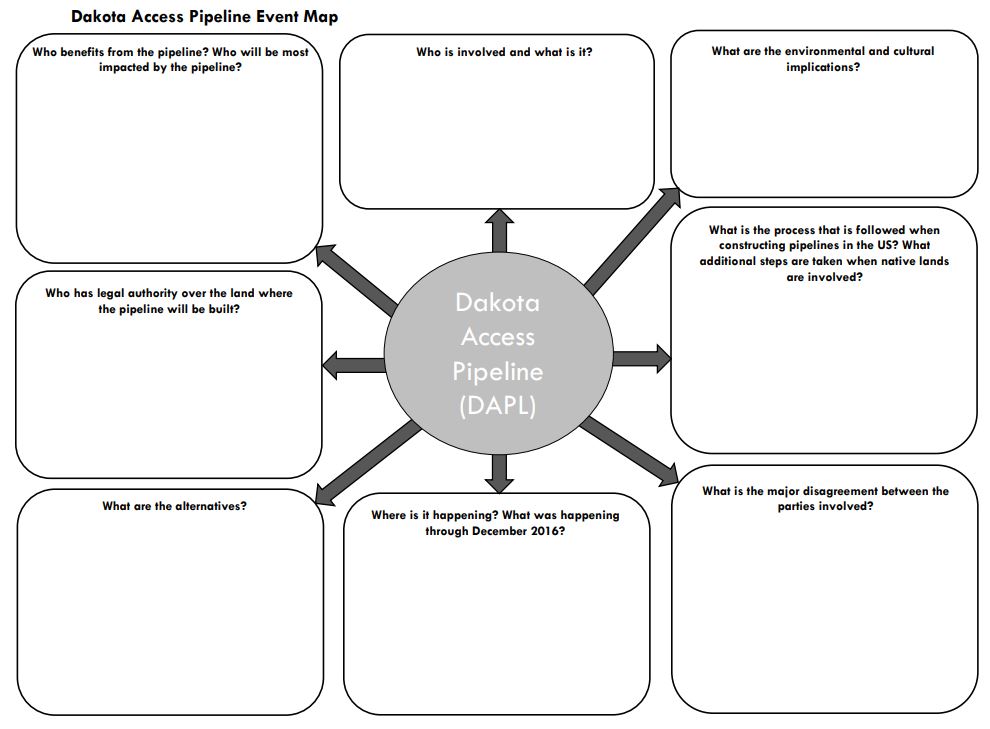
Lastly please answer the following:
- Robert D. Bullard, the dean of the school of public affairs at Texas Southern University, defines environmental justice like this: Environmental justice is defined as the fair treatment and meaningful involvement of all people regardless of race, color, national origin, or income with respect to the development, implementation, and enforcement of environmental laws, regulations, and policies. Is the Dakota Access pipeline an example of environmental injustice? Why or why not?
- Is completing the pipeline — or stopping the pipeline — necessarily a win-lose situation? Is there a compromise solution that might please both protesters and pipeline supporters? And if not, is there a resolution that at least might be deemed fair and equitable considering all of the circumstances?
Our current American, settler-colonial, cultural morality and spirituality are developed from a particular worldview. For example, how we understand nature is firmly rooted in the particular ways in which we view the world. From a Western worldview, nature is to be studied, harnessed, developed and exploited. From an Indigenous worldview, humanity is formed by nature — not the opposite. In an Indigenous worldview we are intricately related to all other parts of creation. This worldview, when it was the dominant worldview on Turtle Island (America), generally produced harmony and a relatively light impact on the earth, at least up until the spread of settler-colonialism and modern capitalism.
We are using North America as an example but there are water issues between Indigenous people and European settlers in Ecuador, Colombia, Chile, Brazil and Peru as well.

No comments:
Post a Comment