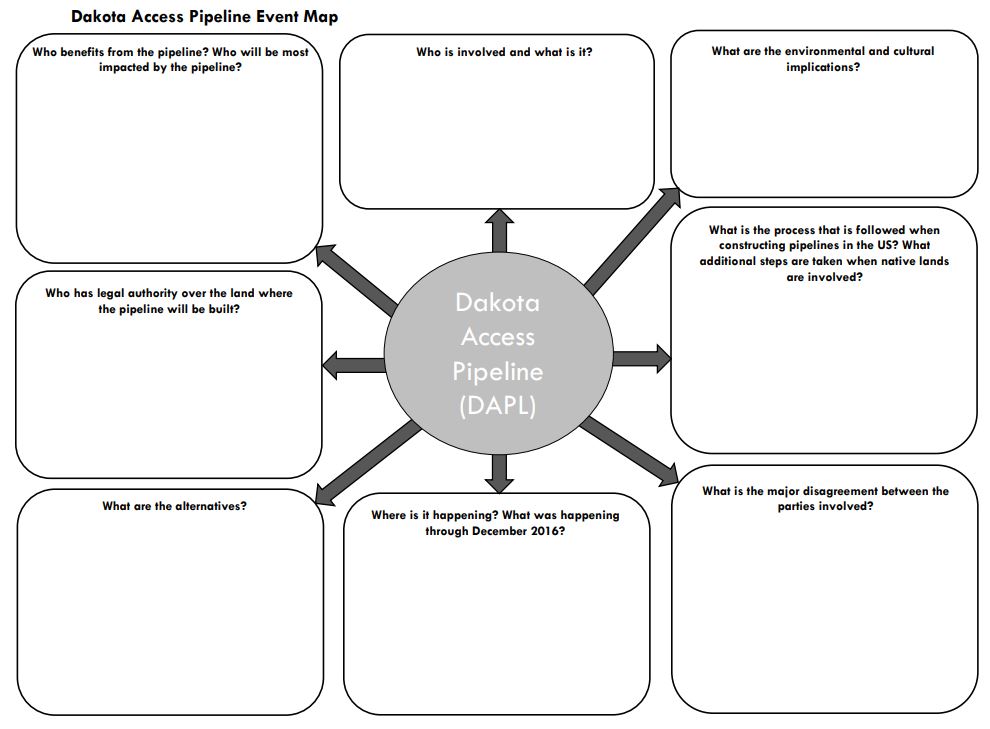
C & D Blocks Environmental and Social Sciences - In C (with Young in the LC) we'll be back in the Learning Commons to continue work on the Standing Rock Sioux Tribe protest from 2016 in the Oceti Sakowin Oyate Territory over the Dakota Access Pipeline. From Hyphen magazine:
Between 1779 and 1871, the US entered over 500 treaties with Native American tribes, all of which have been broken or nullified. One of the largest acts of abuse was the Dawes Act, which allowed the federal government to divide land for Westward expansion and began a period of forced assimilation by turning Native Americans into subsistence farmers and removing tribal governments. The consequences of this act carried on into the 1970s during the Boarding School Era, where Native American children were taken from their families, made to cut their hair, change their names, and relinquish their language and traditions, often while facing physical and sexual abuse...a pattern similar to here in Canada.So first...please watch the Mni Wiconi video then complete the handout I'll give you
- Robert D. Bullard, the dean of the school of public affairs at Texas Southern University, defines environmental justice like this: Environmental justice is defined as the fair treatment and meaningful involvement of all people regardless of race, color, national origin, or income with respect to the development, implementation, and enforcement of environmental laws, regulations, and policies. Is the Dakota Access pipeline an example of environmental injustice? Why or why not?
- Is completing the pipeline — or stopping the pipeline — necessarily a win-lose situation? Is there a compromise solution that might please both protesters and pipeline supporters? And if not, is there a resolution that at least might be deemed fair and equitable considering all of the circumstances?
In D (With Benton) you'll look at what is a First Peoples relationship with water? How is TEK (traditional ecological knowledge) used to assess the health of a freshwater system? We will be drawing food webs using text field guides as references and defining healthy ecological relationships. Reflections on “honoring water” comparing the BC government with those of the AFN
A Block Physical Geography - Okay...Lets get this out of the way right now....No, the horribly bad 2003 movie "The Core" is not possible! No, not just bad but impossibly so.
We do not have the technology to burrow our way to the core of the earth and detonate a nuclear device in order to start the liquid outer core rotating. Sigh...so horrible ;)
Today we start with tectonics and the internal structure/composition of the earth. We'll take some notes down in the week 3 package on core, mantle, and crust and then, you may use the Earth Interior web page or the Dynamic Earth webpage or the Lumen Understanding Earth’s Interior page or the National Geographic Earth Interior page or the Live Science Earth Interior page to help with questions 7 & 8 from page 366 of your Geosystems text (answers can be found between pages 334 and 336 of the text).
 Use
this diagram for your notes in the week
Use
this diagram for your notes in the weekFor the rest of the class you may work on your Prince Rupert topographic map questions.
B Block Human Geography - Today we'll try to answer the Key Question "Why Is Global Population Increasing"? Geographers most frequently measure population change in a country or the world as a whole through three measures - crude birth rate, crude death rate, and natural increase rate and we'll look at those today along with measures of fertility and mortality along with population pyramids.
You'll have some questions to work on for me in order to understand our key concept:
- About how many people are being added to the world’s population each year?
- How does the TFR in your family compare to the overall figure for North America?
- Match the Country with the population pyramid and explain why (Canada, Chad & Germany)
- Name a type of community that might have a lot more males than females. Why so?

No comments:
Post a Comment
Note: Only a member of this blog may post a comment.